
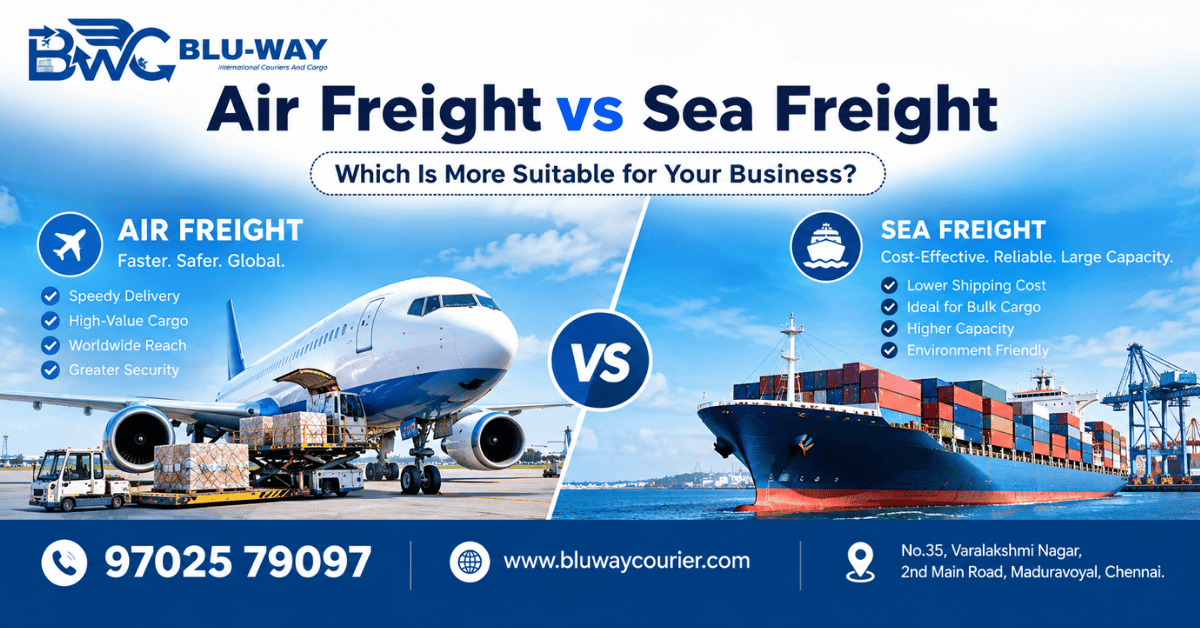
Air vs Sea Cargo: Which International Shipping Option Is Right for Your Business?
When your business needs to ship goods internationally, one of the most important decisions is choosing the right transportation method. Air cargo and sea cargo are two widely used options for international shipping, but each method has different advantages, costs, transit times, and suitability depending on your shipment.
For businesses in Chennai and across India, choosing between air freight and sea freight can have a direct impact on delivery schedules, inventory planning, logistics costs, and customer satisfaction.
So, which is the right option for your business?
The answer depends on several factors, including the type of goods, shipment size, weight, destination, urgency, budget, and delivery requirements.
In this guide, we will explain the differences between air cargo and sea cargo, when to choose each option, what businesses should consider before shipping internationally, and how to select a suitable international cargo service.
To learn more about international courier and cargo solutions, visit the BLU-WAY International Couriers & Cargo website.
What Is Air Cargo?
Air cargo, also known as air freight, is the transportation of goods by aircraft. It is commonly used for international shipments where faster transportation is an important requirement.
Air freight can be suitable for a variety of shipments, including business documents, product samples, electronics, spare parts, garments, commercial goods, urgent orders, and other eligible products.
The biggest advantage of air cargo is generally its faster transit time compared with sea transportation. Businesses that need to send products quickly to overseas customers may consider air freight when delivery speed is a priority.
For example, imagine that a business customer in another country urgently needs a replacement component to continue production. Waiting for a longer transportation cycle could affect their operations. In such situations, a faster international shipping method may be more appropriate.
When Should You Consider Air Cargo?
- Your shipment is time-sensitive.
- Your customer requires faster delivery.
- You are shipping relatively small or lightweight cargo.
- You are sending product samples or prototypes.
- You need to replenish overseas inventory quickly.
- The goods have a high commercial value compared with their weight.
- You have an urgent business shipment.
- Delivery speed is more important than minimizing transportation cost.
However, the actual suitability of air freight depends on the shipment, destination, applicable regulations, and available service.
What Is Sea Cargo?
Sea cargo, also called sea freight or ocean freight, involves transporting goods using ships through international sea routes.
Sea freight is commonly used for larger commercial shipments, bulk cargo, heavy goods, machinery, inventory, and other shipments where businesses can accommodate a longer transportation period.
One of the important characteristics of sea cargo is its ability to handle large quantities of goods. This makes it an important option for businesses involved in manufacturing, wholesale, import, export, trading, and international commerce.
Sea transportation generally takes longer than air transportation. A shipment may also involve port handling, customs procedures, documentation, inland transportation, and final delivery arrangements.
For businesses that can plan their international shipments in advance, sea cargo can be a practical option depending on the cargo type, destination, and service requirements.
When Should You Consider Sea Cargo?
- You are shipping large or heavy goods.
- Your shipment volume is high.
- The delivery deadline is flexible.
- You are moving commercial inventory.
- You are shipping machinery or bulky products.
- You can plan your shipment well in advance.
- Transportation capacity is an important consideration.
- You do not require the faster transit associated with air freight.
Air Cargo vs Sea Cargo: Key Differences
Before choosing an international shipping method, businesses should look beyond the basic freight price.
Transit time, cargo size, weight, destination, handling requirements, customs documentation, packaging, and final delivery all play an important role.
Transit Time
Air freight is generally faster, while sea freight generally takes longer due to ocean transportation and additional port and inland handling.
Shipment Size & Weight
Air cargo is commonly considered for smaller or lighter shipments, while sea cargo is widely used for larger and heavier commercial shipments.
Transportation Cost
Air freight can involve higher transportation costs, while sea freight may be considered for larger shipments with more flexible delivery timelines.
1. Transit Time
The most noticeable difference between air cargo and sea cargo is transportation time.
Air freight is generally faster because goods are transported by aircraft. This makes it useful for urgent shipments and businesses with tight delivery schedules.
Sea freight generally takes longer because goods travel by ocean vessels and may require additional port and inland handling.
If your business has a strict customer deadline, air cargo may be considered. If your business can plan around a longer transit period, sea cargo may be an option.
2. Shipment Size and Weight
The physical characteristics of your shipment are also important.
Air cargo is commonly considered for smaller or lighter shipments, while sea cargo is widely used for larger and heavier commercial shipments.
For example, sending a small quantity of product samples to an overseas customer may require a different solution from shipping a large quantity of finished products for a distributor.
Before booking, businesses should provide accurate information about the shipment's dimensions, weight, quantity, and packaging.
3. Transportation Cost
Cost is another major consideration in international shipping.
Air freight can involve a higher transportation cost because faster transportation is being used. However, the value of faster delivery may justify the cost for certain business shipments.
Sea freight can be considered for larger shipments where the business has more flexibility regarding delivery time.
However, businesses should avoid comparing only the basic freight charge.
- Pickup charges
- Packaging
- Freight charges
- Documentation
- Customs-related charges
- Handling
- Destination charges
- Inland transportation
- Final delivery
Therefore, it is better to compare the overall shipping requirement rather than focusing only on one price component.
Air Freight vs Sea Freight: Which Is More Suitable for Your Business?
There is no universal answer because every business shipment is different.
A company selling fashion products online may need to send smaller quantities regularly to international customers. Another company manufacturing industrial equipment may need to transport large and heavy cargo.
The first business may prioritize speed and flexibility, while the second may need greater cargo capacity and advance planning.
This is why businesses should evaluate their shipment based on actual requirements.
How Urgent Is Your Shipment?
Ask yourself an important question:
How quickly does the shipment need to reach the destination?
If the shipment is urgent, air cargo may be considered because it generally offers faster transportation.
If the shipment is not urgent and the customer or business can accommodate a longer delivery timeline, sea cargo may be considered.
For example, an urgent spare part required for production may have a very different shipping requirement from inventory that is being planned several weeks in advance.
Understanding the real deadline can help prevent unnecessary shipping costs.
Choosing the Right Shipping Method Based on Product Type
Different products can have different logistics requirements.
Documents and Business Materials
Important documents and business papers are usually lightweight and may require faster delivery. International courier or express services may be suitable depending on the destination and urgency.
Product Samples
Businesses frequently send samples to overseas customers before receiving larger orders. Air transportation can be considered when the customer needs to receive the sample quickly and the shipment is relatively small.
Electronics and Small Commercial Goods
Electronics, components, accessories, and other smaller commercial goods may require careful packaging and shipment handling.
Machinery and Heavy Goods
Large machinery and heavy commercial goods may require specialized cargo planning. Sea cargo can be considered for suitable heavy or bulky shipments.
Bulk Inventory
Businesses moving larger quantities of inventory may consider sea freight when the delivery schedule allows sufficient planning time.
Shipment Requirements
The final choice should always depend on the shipment details and available logistics options.
Customs and Documentation in International Shipping
International shipping is not simply about moving a package from one country to another.
Documentation and customs procedures are important parts of the shipping process.
Depending on the shipment and destination, businesses may need documents such as:
- Commercial invoice
- Packing list
- Shipping documents
- Product information
- Export-related documentation
- Other documents required by the destination country
Requirements can vary depending on the product, destination, value, and applicable regulations.
Providing accurate shipment information can help reduce avoidable issues during the shipping process.
Businesses should also ensure that goods are packed appropriately for transportation.
Why Proper Packaging Matters
Whether you choose air cargo or sea cargo, proper packaging is essential.
Goods may pass through multiple stages during international transportation, including pickup, sorting, handling, loading, transportation, customs processing, unloading, and final delivery.
Suitable packaging helps protect products during normal handling and movement.
- Product type
- Fragility
- Weight
- Dimensions
- Moisture protection
- Cushioning
- Outer packaging
- Labeling
- Handling requirements
- Special packaging considerations
Fragile, sensitive, or valuable products may require additional packaging considerations.
Why Shipment Tracking Is Important
For businesses, knowing where a shipment is can make international logistics easier to manage.
Tracking allows customers and businesses to monitor available shipment updates and communicate more effectively regarding delivery progress.
This is especially useful when businesses regularly send international orders and need to provide shipment information to their customers.
If you are shipping with BLU-WAY and your shipment has tracking availability, you can use the BLU-WAY Track Order page to check shipment updates.
International Cargo from Chennai
Chennai is an important commercial and industrial centre, with businesses regularly shipping products and documents to destinations across India and overseas.
Manufacturers, exporters, importers, traders, online businesses, wholesalers, and service companies may all have different international shipping requirements.
For a Chennai business sending a small urgent parcel to an overseas customer, speed may be an important consideration.
For a manufacturer sending larger quantities of commercial goods, shipment capacity and planning may be more important.
This is why international cargo from Chennai should be planned based on the actual requirements of the shipment.
BLU-WAY International Couriers & Cargo provides courier and cargo solutions for businesses that need support with international shipping.
You can learn more about the company and its approach to courier and cargo services through the BLU-WAY About Us page.
Air Cargo or Sea Cargo: Questions Businesses Should Ask
Before choosing a shipping method, consider these questions:
1. What is the destination?
Shipping routes, customs procedures, handling requirements, and delivery arrangements can vary by country and location.
2. What are the dimensions and weight?
Accurate shipment measurements can help determine the appropriate transportation option.
3. How urgent is delivery?
If the customer has a strict deadline, transit time becomes an important consideration.
4. Is the shipment bulky or heavy?
Large commercial cargo may require a transportation method designed to handle greater shipment volumes.
5. What is the value of the goods?
Consider how delivery time can affect your inventory, customer relationships, and business operations.
6. Are special documents required?
Check documentation requirements before dispatch to avoid unnecessary delays.
7. Does the shipment need tracking?
For business shipments, tracking and shipment visibility can make communication with customers easier.
A Simple Decision Guide
You can use the following basic approach when evaluating your shipping requirement:
- Speed is a high priority.
- The shipment is urgent.
- The cargo is relatively small or lightweight.
- Your customer needs the goods quickly.
- Faster inventory replenishment is important.
- The shipment is large or heavy.
- You are moving larger commercial quantities.
- Delivery time is more flexible.
- You can plan your shipment in advance.
- Cargo capacity is an important consideration.
This is only a general guide. The appropriate shipping method can depend on your specific cargo, destination, regulations, and available services.
Why Businesses Should Compare the Complete Shipping Process
One common mistake businesses make is choosing a shipping method based only on price.
A lower freight price may not necessarily mean lower overall business cost if the shipment takes significantly longer and affects inventory or customer delivery.
Similarly, a faster shipping option may not always be necessary if the goods are not time-sensitive.
The better approach is to consider the complete logistics picture:
Understanding this complete process can help businesses make better-informed international shipping decisions.
Air Cargo vs Sea Cargo: Quick Comparison
| Factor | Air Cargo | Sea Cargo |
|---|---|---|
| Transit Time | Generally faster | Generally longer |
| Shipment Size | Often suitable for smaller shipments | Commonly used for larger shipments |
| Weight | Commonly considered for lighter cargo | Commonly used for heavy cargo |
| Urgency | Suitable for time-sensitive requirements | Better suited to flexible delivery timelines |
| Cargo Capacity | More limited compared with sea transportation | Suitable for larger cargo volumes |
| Planning | Can be useful for urgent requirements | Often requires advance planning |
| Typical Business Use | Urgent orders, samples, documents and smaller commercial goods | Bulk inventory, machinery, heavy and larger commercial shipments |
International Courier and Cargo Services for Businesses
Whether you are sending documents, samples, commercial products, bulk cargo, or other eligible goods, selecting an experienced international shipping partner can simplify the logistics process.
A professional cargo service can help businesses understand available shipping options, required shipment details, documentation, transportation methods, and tracking procedures.
To explore the available services, visit the BLU-WAY International Courier and Cargo Services page.
Frequently Asked Questions
Is air cargo faster than sea cargo?
Is sea cargo suitable for large shipments?
Is air freight suitable for urgent business shipments?
Which is cheaper, air cargo or sea cargo?
Can I track my international shipment?
Can businesses ship internationally from Chennai?
How do I choose between air and sea freight?
Get International Shipping Assistance
Looking for international courier, air cargo, sea cargo, or international shipping services from Chennai? Contact BLU-WAY International Couriers & Cargo to discuss your shipment requirements and available shipping options.
Contact BLU-WAY Explore ServicesConclusion: Making the Right International Shipping Decision
Choosing between air cargo and sea cargo is an important decision for businesses involved in international shipping.
Air freight is generally associated with faster transportation and can be considered for urgent, smaller, lightweight, or time-sensitive shipments.
Sea freight is commonly used for larger, heavier, and higher-volume shipments where businesses can accommodate longer transportation times and plan their logistics in advance.
The right choice depends on your specific business requirement.
Before booking an international shipment, consider the cargo type, weight, dimensions, destination, urgency, documentation, packaging, tracking, and complete logistics cost.
If you are looking for international courier, air cargo, sea cargo, or international shipping services from Chennai, BLU-WAY International Couriers & Cargo can help you understand the available shipping options for your requirement.
Visit the BLU-WAY International Couriers & Cargo website to learn more, explore the international courier and cargo services , or contact BLU-WAY to discuss your shipment requirements.
You can also follow BLU-WAY International on Instagram for updates and information.